
Last Updated: October 25, 2026
Quick Summary
You spot storm damage on roof shingles by walking the perimeter from the ground with binoculars, starting on the side that faced the storm. Look for missing, lifted, or creased shingles, dark impact spots, and fresh granule buildup in gutters and at downspout bases. Dented gutters, vents, and flashing confirm hail rather than ordinary wear.
- Never climb onto a wet or storm-damaged roof; inspect from the ground, a stable ladder, or the attic.
- Fresh granule buildup in gutters and at downspout bases points to recent hail impact damage.
- Pea-size to marble-size hail usually causes granule loss and light surface bruising.
- Quarter-size to golf-ball-size hail often produces bruised mats, fractured mats, and dented metal.
- Storm damage is sudden and localized, while aging wear is uniform across all slopes.
Table of Contents
- What Storm Damage on Roof Shingles Looks Like From the Ground
- Hail Damage on Roof Shingles: Impact Marks, Dents, and Granule Loss
- Wind Damage to Roof Shingles: Lifted, Creased, and Missing Shingles
- How to Inspect a Roof After a Storm: A Step-by-Step Walkthrough
- Step 1: Walk the Perimeter From the Ground
- Step 2: Check the Ground and Gutters
- Step 3: Inspect the Attic From Inside
- Step 4: Check Ceilings and Walls Below the Roof
- Step 5: Look at Flashing, Vents, and Roof Edges
- Step 6: Document Everything Before You Call Anyone
- Step 7: Book a Professional Inspection If You Find Any Sign of Damage
- Classify What You Find: Emergency, Prompt Repair, or Monitor
- Storm Damage vs Normal Aging: How to Tell the Difference
- Roof Damage Documentation for Insurance: Building a Claim File
- When to Call a Professional for a Storm Damage Roof Inspection
- Frequently Asked Questions
What Storm Damage on Roof Shingles Looks Like From the Ground
Most homeowners never look at their roof until water is dripping through the ceiling. That is a costly habit. Spotting the signs of storm damage on roof shingles early, from the safety of your own yard, is the single best way to catch a small problem before it becomes a full replacement. At Sunset Restoration, we have walked many properties after Front Range hailstorms, and the evidence is often visible from the ground if you know where to look.
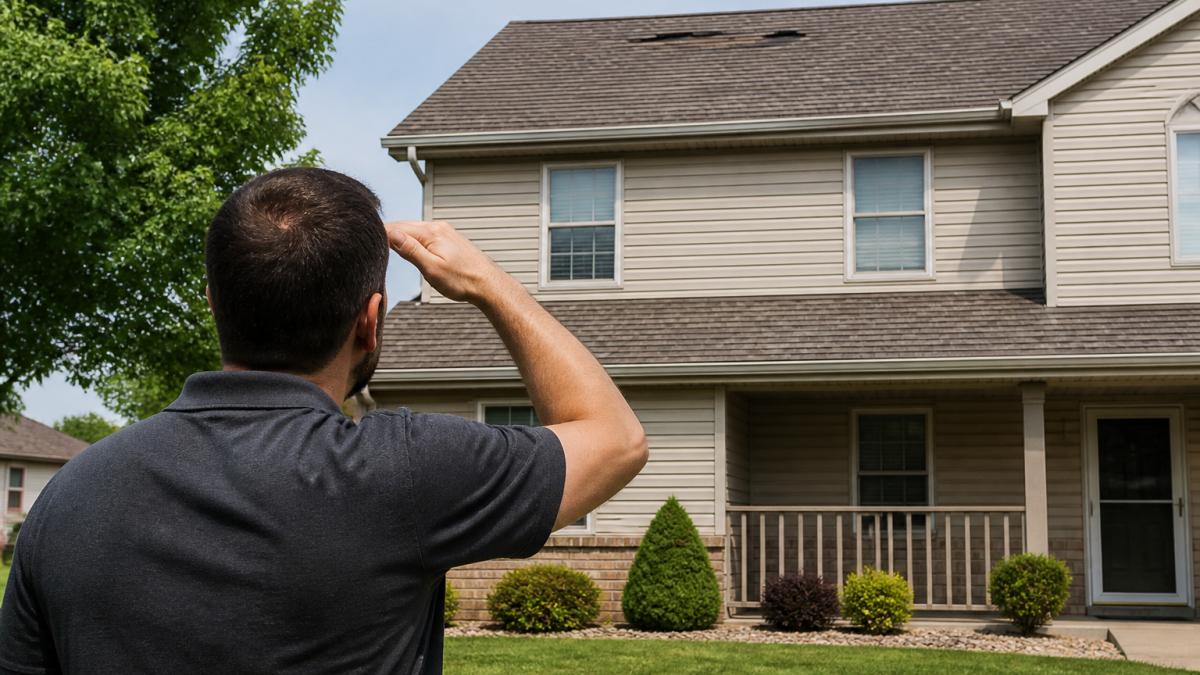
Start With a Ground-Level Walkaround
Grab a pair of binoculars and walk the full perimeter of your home. Start on the side that faced the storm.
Look up, but keep your feet on the grass. Never climb onto a wet or storm-damaged roof.
Scan each slope slowly. Note anything that looks out of place, and take photos from the ground as you go.
What to Look For on the Roof Surface
You do not need to be a roofer to spot the obvious stuff. Focus on these visible signs:
- Missing shingles that leave bare patches of underlayment or deck
- Loose or lifted shingles flapping at the edges
- Curled shingle edges that no longer lie flat
For a closer look at what hail does to shingles in this region, our guide on how to spot roof damage after a Colorado hailstorm walks through the visual signs step by step.
Hail Damage on Roof Shingles: Impact Marks, Dents, and Granule Loss
Hail damage on roof shingles is the hardest storm damage to see from the ground, and the easiest to misread.
The clearest ground-level clue is granule loss. Asphalt shingles shed grit as they age, but a fresh hailstorm leaves a sudden, heavy trail of granules. Check your gutters, the ground at the base of downspouts, and the bottom of any valley where runoff concentrates.
What Hail Size Typically Does to Asphalt Shingles
Hail damage is not all-or-nothing. The size of the stones and the age of the shingle both change what you will see. A common pattern for hail damage on roofs:
- Pea-size to marble-size hail (roughly 1/4 to 1/2 inch) usually causes granule loss and light surface bruising. On a newer shingle, this may be cosmetic; on a shingle past the midpoint of its service life, it can shorten the remaining life.
- Quarter-size to golf-ball-size hail (roughly 3/4 to 1 3/4 inches) is where bruised mats, fractured shingle mats, and dented metal become common. This is the range that most often produces a legitimate insurance claim.
- Baseball-size hail and larger (2 3/4 inches and up) frequently fractures the shingle mat outright, cracks the fiberglass core, and damages underlayment, vents, and flashing. Damage at this level is usually obvious from the ground.
These are general patterns, not a guarantee. Shingle age, manufacturer, and the angle of impact all shift the outcome, which is why a hands-on inspection still matters.
Hail Damage vs Ordinary Wear: The Freshness Test
Granule loss alone does not prove hail. The distinguishing question is timing and pattern:
- Fresh hail damage is localized to the slopes that faced the storm, appears suddenly after a known event, and is often accompanied by dented gutters, downspouts, vents, or HVAC equipment on the roof.
- Ordinary aging is uniform across all slopes, develops gradually over years, and shows thinning, curling, and granule loss evenly rather than in clusters.
If the granule loss is concentrated on one or two slopes and the metal on the roof is dented, hail is the likely cause. If the wear is even and matches the roof’s age, it is more likely aging.
Corroborating Evidence: Metal Tells the Story
Dented gutters, downspouts, vents, and flashing are strong corroborating evidence. Metal dents at the same height and on the same side of the house as the shingle damage are hard to explain any other way. Photograph those dents alongside the shingle damage, because they help an adjuster connect the roof to the storm rather than to wear.
Do not assume a shingle is undamaged because it still looks intact. A bruised mat can hold together for months before it cracks and leaks. If you find soft spots or fresh granule trails, treat the roof as damaged until a professional says otherwise.
For a closer look at what hail does to shingles in this region, our guide on how to spot roof damage after a Colorado hailstorm walks through the visual signs step by step.
Hail size and shingle age both change what damage you will see, and the general pattern runs like this.
| Hail size | Approximate diameter | Typical effect on asphalt shingles |
|---|---|---|
| Pea-size to marble-size | 1/4 to 1/2 inch | Granule loss and light surface bruising |
| Quarter-size to golf-ball-size | 3/4 to 1 3/4 inches | Bruised mats, fractured mats, dented metal |
| Baseball-size and larger | 2 3/4 inches and up | Fractured shingle mat, cracked fiberglass core, underlayment damage |
Wind Damage to Roof Shingles: Lifted, Creased, and Missing Shingles
Wind damage to roof shingles shows up differently than hail. High winds get under the shingle tabs and peel them back.
Missing shingles are the most obvious sign. But pay attention to the ones that are still there.
Check the roof edges and the ridge line first. Those areas catch the most wind. Also look at the siding and any fallen branches, because wind that damages siding usually hits the roof too.
How to Inspect a Roof After a Storm: A Step-by-Step Walkthrough
Knowing how to inspect a roof after a storm comes down to a safe, repeatable routine. The most important rule is the one most guides skip: stay off the roof. Wet shingles, loose granules, and hidden fractures make a post-storm roof one of the most dangerous surfaces on the property. Everything below can be done from the ground, from a ladder placed on stable footing, or from inside the attic.
Step 1: Walk the Perimeter From the Ground
Grab binoculars and walk the full perimeter, starting on the side that faced the storm. Photograph each slope as you go. Note missing shingles, lifted tabs, creases, dark impact spots, and debris. Do not climb onto the roof to confirm what you see; mark it and move on.
Step 2: Check the Ground and Gutters
Look at the ground at the base of downspouts and in gutters for fresh granule buildup. Check for dented gutter runs, loose hangers, and downspouts that have pulled away from the house. These are often the first visible evidence of hail or wind.
Step 3: Inspect the Attic From Inside
This is the step most homeowners skip, and it is the safest place to gather real evidence. With a flashlight, look at the roof deck and rafters for:
- Dark water stains or streaks on the wood
- Damp or darkened insulation
- Daylight showing through the roof deck
Photograph anything you find. Attic evidence is often what convinces an adjuster that the exterior damage is real and active.
Step 4: Check Ceilings and Walls Below the Roof
Walk the rooms under the damaged slopes. Brown rings, bubbling paint, sagging drywall, and a musty smell mean water is getting in. Recurring leaks after every storm are a sign the roof structure has been compromised.
Step 5: Look at Flashing, Vents, and Roof Edges
From the ground or a stable ladder, check the flashing around chimneys, skylights, and wall intersections. Loose or bent flashing lets water slip behind the shingles. Cracked vent seals do the same. Check the ridge line and roof edges first, because those areas catch the most wind.
Step 6: Document Everything Before You Call Anyone
Take dated photos of every slope, every impact mark, every dented piece of metal, and every interior stain. Keep a written log of the storm date and what you observed. Do not repair anything before you have documented it.
Step 7: Book a Professional Inspection If You Find Any Sign of Damage
A trained inspector can safely get on the roof, check the deck and flashing, and separate storm damage from wear. Do this before you file a claim if you can, so the documentation is complete.
Classify What You Find: Emergency, Prompt Repair, or Monitor
Not every sign means the same urgency. A simple triage helps you decide what to do next:
- Emergency (act now): active water intrusion into the home, a missing section of shingles exposing the deck, or a sagging roofline. These warrant temporary protection such as tarping and a same-day call to a professional.
- Prompt repair (within days): lifted or creased shingles, dented flashing, or localized granule loss on one slope. These are likely to worsen with the next storm and should be inspected soon.
- Monitor: minor granule loss on an older roof with no interior signs and no metal dents. Photograph it, note the date, and recheck after the next storm.
Temporary protection is not a repair. A properly installed tarp can limit further water intrusion while you wait for an inspection, but it does not restore the roof and should be documented with dated photos for your claim file.
If you want to go deeper on the leak side, our 7-step DIY roof leak inspection guide covers the interior checks in detail.
Storm Damage vs Normal Aging: How to Tell the Difference
Telling storm damage apart from normal aging is the question that decides most insurance claims. Aging shows up evenly: shingles wear thin, granules slowly wash away, and the surface dulls across the whole roof.
A simple test is timing. If the wear matches the age of the roof and looks uniform, it is likely aging.
Roof Damage Documentation for Insurance: Building a Claim File
Roof damage documentation for insurance is what turns a visible problem into a paid claim. Start a file the day you spot damage, before anything is repaired. A strong claim file includes:
- Dated photos of every slope, plus close-ups of impact marks
- Photos of dented gutters, vents, and downspouts
- A written log of the storm date and what you observed
Keep every photo time-stamped and organized. If your insurer pushes back, our guide on what to do when insurance denies your roof claim explains your next steps, and our full walkthrough of the roof hail damage insurance claim process shows how to build the file from day one.
When to Call a Professional for a Storm Damage Roof Inspection
Call a professional when you see missing shingles, active leaks, or damage you cannot safely confirm from the ground.
Be careful who you hire. After a big hailstorm, out-of-town contractors appear fast. Before you sign anything, read our guide on how to identify storm chaser roofing companies so you avoid the ones that vanish after the check clears.
At Sunset Restoration, we are a family-owned, licensed team with more than 10 years serving the Denver metro and Thornton areas. We inspect, document, and assist you through the insurance process, and we offer flexible financing, including interest-free options for qualified homeowners, so urgent repairs do not have to wait.
Frequently Asked Questions
Can you check for storm damage on roof shingles safely from the ground?
Yes, most of the first-pass inspection can be done from the ground with binoculars. Walk the perimeter and look for missing, lifted, or creased shingles, dark impact spots, granules collecting at downspout outlets, dented gutters, and damaged flashing or vents. Ground-level checks keep you off a wet, steep surface. Leave the close-up shingle examination, especially on steep pitches, to a licensed roofer who has fall protection and knows what hail bruising looks like underfoot.
How long after a storm should you inspect your roof?
Inspect as soon as it is safe, ideally within the first few days. Wind and hail damage on roof shingles can let water in at the next rain, and small lifted areas spread with each gust. Insurance policies also have prompt-notice requirements, so a dated inspection record helps your claim. If a storm dropped large hail or you heard impacts on windows or siding, schedule a professional inspection even if the roof looks fine from the street.
What is the difference between hail damage and normal wear on asphalt shingles?
Normal aging shows up as even, gradual granule loss, curling edges across the whole roof, and shingles that look worn rather than struck. Hail damage on roof shingles is random and localized: soft bruises, dark impact spots, cracked or torn shingles, and exposed fiberglass mat in scattered clusters. Damage usually concentrates on slopes facing the storm, along ridges, and on metal components like vents and gutters. A roofer can confirm the difference with a close inspection and photos.
What should you do if you find missing or damaged shingles?
Photograph the damage from the ground, note the date and storm, and keep any shingle pieces or granules you collect. Do not climb onto a wet or steep roof to make temporary repairs. Call a licensed contractor for an inspection and a written scope, and ask whether the damage supports an insurance claim. Prompt roof repair prevents water intrusion, rot, and mold, and a documented inspection protects your roof damage documentation for insurance if you file.
Storm damage rarely gets better on its own. Every week you wait, a small lifted shingle can turn into a rotted deck and a bigger claim. Sunset Restoration brings licensed experts, honest documentation, and insurance claim support to every inspection, along with clear communication from the first call to the final walkthrough. Get started with Sunset Restoration and get a straight answer on your roof today.

