
Table of Contents
- Review Your Denial Letter and Understand Why Your Claim Was Rejected
- Reasons Roof Insurance Claims Are Denied
- Gather and Organize Roof Damage Insurance Claim Documentation
- Request a Reinspection or Independent Roof Inspection
- How Long to File a Roof Insurance Claim Appeal
- Submit a Roof Claim Appeal Letter Template and Supporting Evidence
- Escalate Your Dispute: Appraisal, Public Adjuster, or Legal Help
- Frequently Asked Questions
Last Updated: October 11, 2026
Review Your Denial Letter and Understand Why Your Claim Was Rejected
When your roof insurance claim denial arrives, read it carefully to understand the specific reason for the roof insurance claim denial. Your denial letter contains the reason your claim was rejected, which determines your next move. Common denial reasons include wear and tear, policy exclusions, lack of coverage, or insufficient damage documentation.
Common denial reasons and what they mean
Wear and tear: Your insurer believes the damage is from normal aging, not a covered event like a storm.
Policy exclusion: Your policy doesn’t cover this type of damage.
Insufficient documentation: You didn’t provide enough photos, estimates, or proof of damage.
Pre-existing damage: The insurer claims the damage existed before your policy started or before the storm event.
Deductible issue: Your deductible is higher than the repair cost, so there’s nothing to pay out.
Each denial reason requires a different response strategy.
Your denial letter is not final. It’s the starting point for your appeal. The reason stated in that letter tells you exactly what evidence you need to gather next.
Reasons Roof Insurance Claims Are Denied
Wear and tear denials occur when insurers argue damage is gradual deterioration rather than sudden, storm-related loss. To rebut this:
- Obtain an independent roof inspection report documenting impact marks or damage consistent with hail or wind, not age-related wear.
- Provide contractor estimates noting whether damage is storm-related or age-related.
- Submit weather service records proving a storm event occurred on or near your claim date.
- Include roof installation documentation if your roof is under 10 years old.
Wear-and-tear denials are among the most overturnable if you can show the damage pattern is inconsistent with gradual aging.
Missing or inadequate documentation denials happen when your claim file lacks evidence adjusters need to approve payment. To counter this:
- Provide multiple photographs from different angles, showing both close-ups of impact marks and wide shots of affected areas.
- Include a detailed contractor repair estimate with line-item breakdowns.
- Attach an independent roof inspection report, this carries the most weight because it’s unbiased and professionally documented.
- Submit weather documentation proving a covered peril occurred.
- Include photos or videos taken immediately after the storm as dated evidence of damage timing.
Make your claim file complete so the adjuster has no legitimate reason to deny it.
Policy language exclusions are often misapplied by insurers. To address exclusion denials:
- Obtain your full policy document and locate the relevant coverage section.
- Highlight the specific language that covers your damage and quote it in your appeal letter.
- Verify whether the cited exclusion actually applies to your loss; many are narrower than adjusters claim.
- Have an insurance attorney or public adjuster review the policy language to spot misinterpretations.
Timing and notice issues can trigger denials if you file your claim months after the storm. To prevent or rebut timing denials:
- File your claim as soon as you discover damage, ideally within days of the storm.
- If you discovered damage later, document the discovery date and explain why it was not immediately visible.
- Provide photos or inspection reports dated close to the loss event.
- Include documentation showing you reported the damage promptly once aware of it.
Deductible-related denials occur when the estimated repair cost is less than your deductible. To address this:
- Verify your deductible amount in your policy.
- Obtain multiple contractor estimates to confirm repair costs.
- Ask contractors whether bundling related damage might increase the total claim value.
- If your deductible exceeds repair costs, the claim cannot be approved, but you can pursue repairs out-of-pocket.
If your claim was denied for “wear and tear” or “insufficient documentation,” do not assume you’re stuck. These are the most frequently overturned denials when proper evidence is submitted. Many homeowners succeed on appeal by providing the specific documentation outlined above. Timing and deductible denials are harder to overturn but may still be worth challenging if new evidence emerges.
Gather and Organize Roof Damage Insurance Claim Documentation
Documentation is your strongest tool in an appeal. Collect every piece of evidence you have and organize it in a single folder, either physical or digital. Label everything with dates.
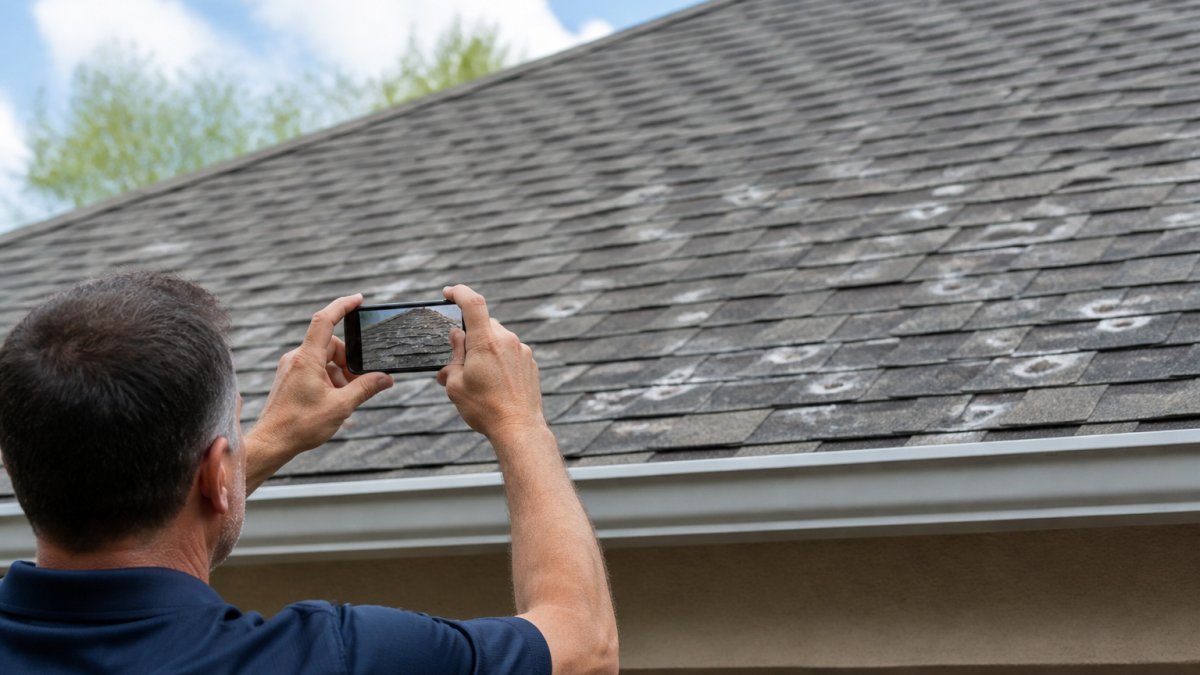
Photos, repair estimates, and inspection reports
Photographs are your foundation. Take photos from multiple angles showing close-ups of damaged shingles and impact marks, plus wide shots of the scope of damage.
Repair estimates from licensed contractors give the insurer a baseline for repair costs.
Inspection reports from independent roof inspectors are powerful.
Weather records prove a storm occurred on your claim date. National Weather Service data, local news reports, or storm tracking services all work.
Organize your documentation in this order:
- Cover letter explaining what’s inside
- Photos (organized by area of roof)
- Contractor estimates
- Independent inspection report
- Weather documentation
- Original denial letter
- Any correspondence with the insurance company
This organized file becomes your appeal package. Present it clearly.
Request a Reinspection or Independent Roof Inspection
After denial, you can request a reinspection from your insurance company or hire an independent inspector. Reinspection requests go directly to your insurance company in a formal letter requesting a different adjuster visit your roof.
Independent inspections are inspections you pay for yourself. You hire a licensed roof inspector with no connection to your insurance company. Independent inspectors cost between a few hundred and a thousand dollars, depending on your roof size and complexity.
If you’re requesting a reinspection, submit it in writing with a deadline. Give the insurance company 10 business days to respond. Document everything in writing so you have a record of your request and their response.
How Long to File a Roof Insurance Claim Appeal
Timing matters in roof insurance claim appeals. Your insurance policy includes a deadline for filing an appeal after denial, typically 30 to 60 days from the denial date. Check your denial letter for the specific deadline.
File your appeal before the deadline in writing, preferably certified mail. Include a cover letter referencing your claim number and the denial reason. Contact your state’s insurance commissioner’s office if you’re unsure about your deadlines.
Submit a Roof Claim Appeal Letter Template and Supporting Evidence
Your appeal letter is your formal response to the denial. It should be professional, specific, and backed by evidence.
What to include in your written appeal
Include: claim number and denial date, a clear statement of disagreement with facts (not emotion), a point-by-point rebuttal of the denial reason, policy language showing your damage is covered, new evidence (photos, estimates, inspection reports, weather records), and a specific request for action (reverse denial, approve claim, or schedule reinspection). Maintain a professional, organized tone throughout.
Here’s a basic template to follow:
[Your Name]
[Your Address]
[Date][Insurance Company Name]
Claims Department
[Address]Re: Appeal of Claim Denial – Claim #[Your Claim Number]
Dear [Claims Manager Name]:
I am writing to formally appeal the denial of my roof insurance claim dated [denial date]. I believe this denial was made in error and should be reversed based on the evidence I am now providing.
Your denial letter stated the reason for denial as: [state the reason]. I respectfully disagree with this determination for the following reasons:
[Explain why the denial reason does not apply to your situation. Use specific facts.]
My policy covers [reference the specific policy language], which applies to my claim. The damage to my roof is consistent with [storm event], not wear and tear or normal aging.
I am enclosing the following documentation that was not available at the time of the initial inspection:
- Photographs of roof damage
- Contractor repair estimate
- Independent roof inspection report
- Weather service documentation
Based on this evidence, I request that you reverse your denial and approve my claim for payment.
I can be reached at [phone number] or [email] if you have questions.
Sincerely,
[Your Signature]
[Your Typed Name]
Send this letter certified mail. Keep a copy for your records. Follow up if you don’t hear back within 30 days.
Escalate Your Dispute: Appraisal, Public Adjuster, or Legal Help
If your appeal is denied, ignored, or only partially approved, you have three formal escalation paths. Each has different costs, timelines, and appropriate use cases. Understanding the trade-offs helps you choose the right next step.
Appraisal: Fast, binding, and built into your policy
What it is: Appraisal is a dispute-resolution process in nearly all homeowners insurance policies.
Cost: Typically $300-$800 per appraiser, split between you and the insurer. If the umpire is needed, costs may reach $1,500-$2,500 total, usually split 50/50.
Timeline: 30-60 days from request to decision.
Outcome: The appraiser’s decision is binding on both parties. You cannot appeal further through the insurance company.
How to request it: Send a written request to your insurance company citing your policy’s appraisal clause.
Public adjuster: Negotiation specialist, takes a percentage
What it is: A public adjuster is a licensed professional who negotiates with your insurance company on your behalf.
Cost: Typically 5-10% of any settlement increase they secure. You pay nothing upfront; their fee comes from the settlement increase only.
Timeline: 30-90 days for negotiation, depending on claim complexity.
When to use it: Public adjusters work best when your claim was undervalued rather than completely denied.
Outcome: If successful, you receive a higher settlement.
How to hire one: Ask your state’s insurance department for a list of licensed public adjusters.
Insurance attorney: Legal representation, contingency or hourly
What it is: An insurance attorney represents you in disputes with your insurance company.
Cost: Most work on contingency, taking 25-40% of any settlement or judgment. You pay nothing upfront.
Timeline: 3-12 months for negotiation and settlement; 1-3 years if litigation goes to trial.
Outcome: If successful, you receive the full settlement or judgment, minus the attorney’s contingency fee.
How to hire one: Search your state bar association’s website for attorneys licensed in insurance law or bad-faith claims.
Decision framework: Which path is right for you?
Use a public adjuster if your claim was undervalued but coverage is not in dispute, you lack time to negotiate, or your claim value is $10,000+.
Use an attorney if the insurer denied coverage entirely, your claim is large ($15,000+), you suspect bad-faith conduct, or appraisal and public adjuster routes have failed.
Combine strategies if needed: You can request appraisal while consulting an attorney, or hire a public adjuster and later hire an attorney if negotiation fails.
Before escalating, send one final appeal letter with any new evidence you’ve gathered. Many insurers reverse denials on second appeal without requiring appraisal or attorney involvement.
Frequently Asked Questions
Why do homeowners insurance companies deny roof claims?
Insurance companies deny roof claims for several reasons: the damage falls outside your policy coverage, wear and tear is deemed responsible instead of a covered event like hail or wind, the claim was filed after the policy exclusion deadline, or the adjuster determines repair costs are below your deductible. Some denials also occur when damage is attributed to lack of maintenance or pre-existing conditions. Review your denial letter carefully to identify the specific reason your roof insurance claim was rejected.
Can I appeal a denied roof insurance claim?
Yes, you can appeal a denied roof claim through several routes. Start by submitting a written appeal with additional documentation, photographs, and a professional inspection report that contradicts the denial. If the insurance company denies your appeal, you can request an appraisal (a binding process where an independent inspector reviews both sides), hire a public adjuster to negotiate on your behalf, or consult an insurance attorney. Each option has different timelines and costs, so choose based on your denial reason and the claim amount at stake.
How long do I have to file a roof insurance claim appeal?
Most states allow homeowners 1-3 years from the date of loss to file or reopen a roof insurance claim, but appeal deadlines are much shorter. After receiving a denial letter, you typically have 30-90 days to submit a written appeal, depending on your state and policy language. Check your denial letter and policy documents for your state’s specific deadline. If you miss the appeal window, you may lose the right to dispute the decision, so act quickly once you receive your denial.
What evidence should I gather after a roof claim is denied?
Collect detailed photographs of all visible roof damage from multiple angles and distances, a written repair estimate from a licensed contractor, a professional roof inspection report, weather reports documenting the storm date and severity, and your original claim documentation. Organize this into a clear evidence packet with dates, descriptions, and any prior maintenance records showing your roof was well-maintained. This documentation strengthens your appeal and gives you credibility if you escalate to appraisal, public adjuster, or legal action.
