
Table of Contents
- What Homeowners Pay for Roof Replacement in 2026
- Roof Replacement Cost by Material: Asphalt, Metal, and Beyond
- Factors That Drive Your Roof Replacement Cost
- Building Your Roof Replacement Estimate Checklist
- How Long Does Roof Replacement Take?
- Roof Replacement Financing Options for Homeowners
- Insurance Claims and Replacement: What You Need to Know
- Getting an Accurate Roof Replacement Quote
- Frequently Asked Questions
Last Updated: October 16, 2026
What Homeowners Pay for Roof Replacement in 2026
A roof replacement is one of the largest home improvement investments most homeowners face. Understanding what residential roof replacement costs in 2026 helps you budget properly and avoid sticker shock.
At Sunset Restoration, we’ve helped hundreds of homeowners navigate this process. The cost of a residential roof replacement depends on your home’s square footage, roof pitch and complexity, materials, and local labor rates. The cost of a complete replacement varies widely depending on individual project specifics.
This guide breaks down how roofing costs actually work, what to expect at each stage, and how to evaluate contractor quotes.
Roof Replacement Cost by Material: Asphalt, Metal, and Beyond
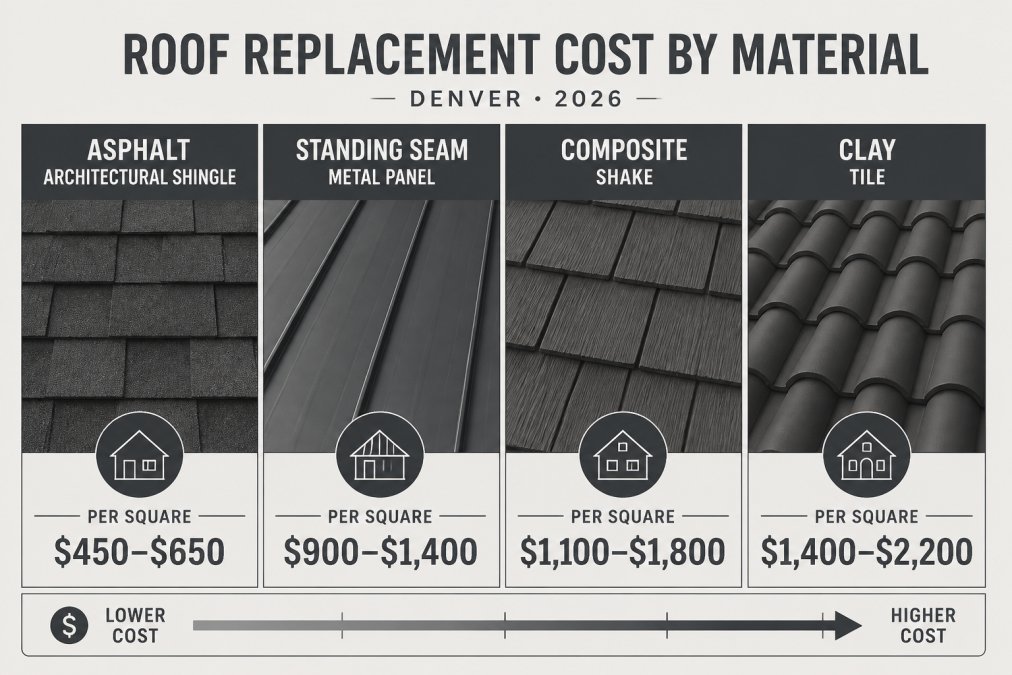
The material you choose is one of the biggest cost drivers for your roof replacement, affecting both the upfront cost and how often you’ll face another replacement.
Roofers price most residential work by the square, one square equals 100 square feet of roof surface.
Below are the installed cost ranges most homeowners see for a typical 22 to 28 square roof with a moderate pitch and a full tear-off. These figures include materials, labor, underlayment, flashing, disposal, and standard permits.
| Material | Installed Cost per Square | Typical Project Total (22-28 squares) | Typical Lifespan |
|---|---|---|---|
| 3-tab asphalt shingles | $350 – $500 | $7,700 – $14,000 | 15-20 years |
| Architectural (dimensional) asphalt | $450 – $700 | $9,900 – $19,600 | 25-30 years |
| Standing seam metal | $900 – $1,600 | $19,800 – $44,800 | 40-70 years |
| Corrugated or exposed-fastener metal | $700 – $1,100 | $15,400 – $30,800 | 30-45 years |
| Composite / synthetic shake or slate | $800 – $1,400 | $17,600 – $39,200 | 30-50 years |
| Clay or concrete tile | $1,000 – $1,800 | $22,000 – $50,400 | 50+ years |
| Natural slate | $1,500 – $3,000+ | $33,000 – $84,000+ | 75-100+ years |
Asphalt shingles remain the most common choice for residential roofs, affordable, easy to install, and available in many colors and styles.
Metal roofing costs more upfront but lasts significantly longer than asphalt. Standing seam panels use concealed clips and expansion joints to handle thermal movement, a detail that separates a 40-year install from a 15-year one. Corrugated and exposed-fastener panels cost less but expose fasteners and gaskets to wear.
Tile and slate are premium options that command the highest prices. These materials are heavy, clay tile can run 900 to 1,200 pounds per square, so the roof structure often needs reinforcement or an engineered evaluation.
Composite and architectural shingles sit in the middle price range, mimicking wood shakes or slate while costing less. They’re more durable than standard asphalt and often carry longer warranties, though the warranty is only as good as the contractor’s workmanship coverage behind it.
Before you compare quotes, confirm every bidder is pricing the same material, the same number of squares, and the same underlayment, otherwise the numbers aren’t comparable.
Factors That Drive Your Roof Replacement Cost
Your actual roof replacement cost depends on far more than material choice. The characteristics of your home and roof determine whether you land on the lower or upper end of the range.
Roof size and home square footage
The larger your roof, the more materials and labor required. Roof size isn’t identical to home square footage because pitch affects surface area, a 2,000-square-foot home with a steep pitch has more roof surface than one with a shallow pitch.
Contractors price by the square (100 square feet) and measure either from the ground using satellite imagery or on the roof for precision. A 2,000-2,500 square foot home with moderate complexity is a common size for projects.
Roof pitch and complexity
A steep pitch costs more to replace than a shallow one, it requires more safety equipment, slower installation, and greater worker risk. A simple gable roof costs less than one with multiple peaks, valleys, dormers, and intersecting planes.
Complexity also includes penetrations, chimneys, vents, skylights, that require careful flashing. Each adds cost because it needs custom work. More than six or seven penetrations plus multiple valleys can add to the base price.
Local labor rates and contractor experience
Labor is typically 40-60% of your total roof replacement cost, and local rates vary. Experienced, licensed contractors charge more than newer roofers, a premium that usually reflects better workmanship, proper insurance, and accountability.
Sunset Restoration brings over 10 years of experience to every project, understanding local building codes and regional weather challenges. When you hire an experienced contractor, you’re paying for knowledge and reliability, not just labor hours.
What a real itemized estimate looks like
Headline prices hide the line items that decide whether a quote is fair. An itemized breakdown for a roof replacement typically includes:
| Line Item | Typical Share of Total |
|---|---|
| Tear-off and disposal of existing layers | 10-15% |
| Underlayment and ice/water shield | 5-8% |
| Shingles and accessories (ridge, starter, hip) | 25-35% |
| Flashing, vents, and pipe boots | 5-10% |
| Labor and installation | 30-40% |
| Permits and inspection fees | 1-3% |
| Contingency for hidden decking damage | 0-10% |
If a bidder quotes a single lump sum, ask for the breakdown in writing. Line items are also where you spot exclusions, whether the price includes replacing rotted decking, upgrading attic ventilation, or removing a second layer of old shingles.
Climate, code, and insurance factors
Roofs in this region face stressors that shape both material selection and cost. Hail exposure drives many homeowners toward impact-rated or Class 4 shingles, which can add to the cost over standard architectural shingles. Snow load requirements influence structural reinforcement, and winter ice means ice-and-water shield is often required along eaves and valleys rather than optional.
Local code also matters. Most jurisdictions limit how many roofing layers a home may carry, determining whether an overlay is legal or a full tear-off is mandatory. Permit fees, inspection requirements, and disposal rules vary and are typically passed through as separate line items.
Insurance is the other major variable. If damage came from a covered event like hail or wind, the claim usually pays the actual cash value first, replacement cost minus depreciation, and releases recoverable depreciation once work is complete. Your deductible is subtracted, and any upgrade beyond like-kind replacement is typically out of pocket. That’s why two neighbors with identical roofs can pay very different amounts.
Insurance adjusters work for the insurance company, not for you. If their estimate seems low compared to contractor quotes, request a second opinion before accepting the settlement, and confirm whether your policy pays replacement cost or actual cash value.
When comparing estimates, watch for vague language like “labor and materials” without breakdown. Detailed, itemized quotes indicate a contractor who understands their costs and stands behind their pricing.
Building Your Roof Replacement Estimate Checklist
Getting accurate estimates requires giving contractors consistent information. Use this checklist when requesting quotes to compare apples to apples.
- Provide your home’s square footage and roof dimensions
- Specify the roof pitch or slope (contractors can measure this)
- List all roof penetrations: chimneys, vents, skylights, exhaust pipes
- Clarify whether you want a full tear-off or an overlay (if applicable)
- Ask about underlayment type and quality
- Request itemized pricing: materials, labor, disposal, permits
- Confirm warranty coverage on materials and workmanship
- Ask about the timeline and project schedule
- Verify insurance and licensing status
- Request references from recent projects
An itemized estimate shows exactly what you’re paying for, materials, labor, disposal, and permits listed separately, so you can compare quotes more effectively.
How Long Does Roof Replacement Take?
Most residential roof replacements take 1-3 days, depending on size and complexity. A straightforward asphalt shingle replacement on a small to medium home typically takes 1-2 days; larger homes, complex designs, or premium materials can extend the timeline.
Weather plays a significant role, rain, high winds, or extreme temperatures can delay work, and unexpected conditions may push the timeline.
Timeline also depends on whether you need a full tear-off or overlay. A tear-off removes all old materials first; an overlay installs new shingles over existing ones, which is faster but only works if the structure can handle the weight and local codes permit it. An overlay can save time.
Roof Replacement Financing Options for Homeowners
If the full cost of roof replacement strains your budget, several financing paths exist. Cash eliminates interest but isn’t feasible for everyone. HELOCs and home equity loans offer lower rates because your home is collateral; personal loans are unsecured but carry higher rates.
Sunset Restoration offers flexible financing options, including interest-free financing for qualified homeowners. This spreads costs over time without interest charges, removing the pressure to choose a cheaper contractor or delay necessary work after storm damage.
Insurance claims can also offset costs. If your roof was damaged by hail, wind, or another covered event, your homeowner’s insurance may cover the replacement, a process requiring proper documentation that we help homeowners navigate regularly.
Insurance Claims and Replacement: What You Need to Know
Storm damage often triggers roof replacement before you planned it. Hail, wind, and fallen trees can compromise your roof, and your policy may cover the replacement cost minus your deductible.
The claim process starts with an adjuster’s inspection to determine whether damage qualifies for coverage. This is where many homeowners face challenges: adjusters sometimes underestimate damage or offer settlements below actual replacement costs.
Having an experienced contractor review the adjuster’s estimate makes a significant difference. At Sunset Restoration, we help homeowners understand whether the insurance estimate reflects the actual scope of work and advocate for appropriate coverage throughout the claims process.
Getting an Accurate Roof Replacement Quote
A quality contractor provides a detailed written quote specifying materials, labor, timeline, warranty terms, and payment schedule.
When contractors visit, they should ask about your budget, timeline, and whether you’re dealing with insurance claims. A contractor who listens is more likely to deliver results that match your expectations.
Sunset Restoration provides transparent quotes with no surprises. Our team explains your options, walks you through the estimate, and answers questions, we’re committed to clear communication from initial quote through project completion.
Request quotes from multiple contractors, but don’t automatically choose the lowest price, the cheapest option often means cutting corners on materials or labor, and the most expensive isn’t always best. Compare what’s included, experience and reputation, warranty terms, and your comfort level.
Your roof replacement is a major investment in protecting your home. Understanding the costs involved, the factors that drive pricing, and how to evaluate contractors puts you in control of the decision. When you’re ready to move forward, Sunset Restoration is here to guide you through the process with transparency, expertise, and care. Get a detailed roof replacement estimate from our experienced team and discover how we make the process stress-free from start to finish.
Frequently Asked Questions
How much does it cost to replace a roof in 2026?
The actual cost of a complete roof replacement depends on your home’s square footage, roof size, material choice, and roof complexity. Contact Sunset Restoration for a personalized estimate based on your specific roof.
How do roofing material choices affect roof replacement cost?
Material is one of the largest cost drivers in roof replacement. Asphalt shingles are the most affordable option, while metal roofing and premium materials cost significantly more upfront but often last longer and require less maintenance. Your choice affects both labor and material expenses. Sunset Restoration can walk you through the pros and cons of each material for your home’s climate and budget.
What factors increase roof replacement cost the most?
Roof pitch, complexity, and home size are the primary cost drivers. Steeper roofs and those with multiple angles, valleys, or architectural features cost more to replace. Larger homes require more materials and labor. Local labor rates also vary. Tear-off complexity, the condition of the roof deck, and whether flashing or underlayment needs replacement can add to the total. A free inspection from Sunset Restoration will identify cost factors specific to your home.
Can I use insurance to cover roof replacement costs?
Insurance may cover roof replacement if damage results from a covered event like hail, wind, or storm damage. Your deductible and coverage limits apply. Many homeowners don’t realize they have coverage or receive lowball estimates from adjusters. Sunset Restoration specializes in insurance claim advocacy and helps homeowners understand their coverage, negotiate fair estimates, and navigate the claims process from inspection through completion.
