
Table of Contents
- Signs of a Roof Leak You Should Never Ignore
- How to Inspect Roof for Leaks: A Step-by-Step Walkthrough
- Roof Inspection Tools That Make Leak Detection Easier
- Roof-Type Nuances: Asphalt, Tile, and Metal Leak Patterns
- Seasonal Roof Maintenance Schedule for Storm-Prone Climates
- When to Call a Professional Roofer
- Documenting Roof Damage for Insurance Claims
- Conclusion
- Frequently Asked Questions
Last Updated: September 29, 2026
Signs of a Roof Leak You Should Never Ignore
Water almost never shows up where the leak starts. It enters at the roof, travels along framing, then drips, a gap that makes homeowners misread the problem.
Interior Warning Signs: Water Stains, Mold, and Attic Moisture
The attic is your best early warning system. Check it after every major storm.
Look for:
- Brown or yellow rings on ceiling drywall
- Dark streaks running down rafters
- Soft or spongy spots in roof sheathing
- A musty smell that never goes away
- White or black patches on wood
Exterior Warning Signs: Curled Shingles, Granule Loss, and Damaged Flashing
From the ground, scan the roof with binoculars. You are looking for shingle integrity, not perfection.
Watch for:
- Curled shingles or buckled shingles
- Bald patches where granules have washed away
- Cracked or lifted flashing around chimneys
- Rusted or bent vent pipes
- Debris piled in valleys and gutters
How to Inspect Roof for Leaks: A Step-by-Step Walkthrough
Learning how to inspect roof for leaks comes down to one rule: follow the water backward. Start inside, work outward, and confirm with a controlled test.
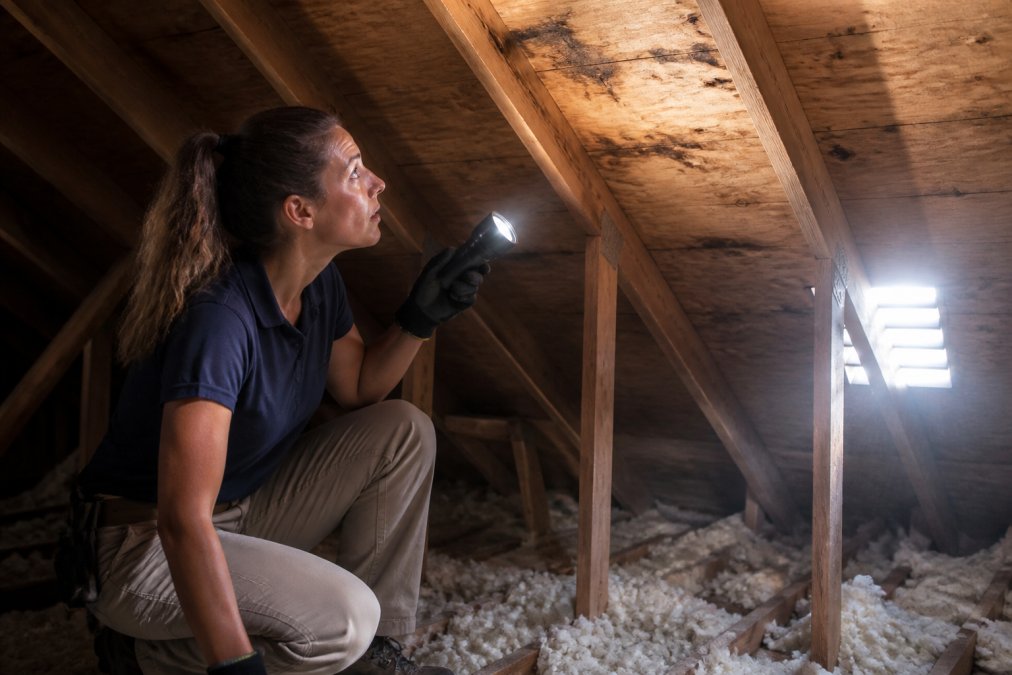
Step 1: Start in the Attic and Trace Water Stains Uphill
A roof leak inspection begins in the attic, not on the roof. Grab a flashlight and moisture meter, and work in daylight or with a headlamp.
Step 2: Check Roof Penetrations, Flashing, and Valley Leaks
Most leaks start at roof penetrations, chimneys, vent pipes, skylights, and valleys, not in the field of shingles.
Inspect these areas:
- Chimney flashing, especially where it meets shingles
- Vent pipe boots and their rubber seals
- Drip edge along the eaves
- Valley leaks where two roof planes meet
- Nail pops and loose fasteners
Step 3: Run a Water Hose Test to Confirm the Leak Source
A water hose test confirms what you suspect. Do this from the ground or a stable ladder, never while standing on a wet roof.
Never run a water hose test alone or on a steep, wet roof. Roof pitch above 6:12 turns a simple slip into a fall. If you cannot reach the area safely, stop and call a pro.
Roof Inspection Tools That Make Leak Detection Easier
Good tools turn guesswork into answers. You do not need a full contractor setup, but knowing what each tool tells you, and what it cannot, changes everything.
The essentials:
- Moisture meter to find hidden damp wood
- Thermal imaging camera to spot temperature gaps
- Binoculars for ground-level checks
- Sturdy ladder rated for your weight
- Safety harness for any roof access
How to Use a Moisture Meter Correctly
A moisture meter is the most useful leak-detection tool because it gives you a number instead of a guess. Pin-type meters press two prongs into suspect wood; pinless meters scan a wider area without leaving marks.
- Calibrate before you trust it. Check the meter against dry framing in an unaffected part of the attic first.
- Read the same spot twice. Wood moisture varies by depth and grain, so take a reading, wait a few seconds, and repeat.
- Compare wet to dry, not wet to a number. The gap between a suspect rafter and a nearby dry one matters more than the absolute percentage.
- Mark and recheck. Flag the spot with tape and re-measure after the next rain; a climbing reading confirms active intrusion, while a steady one may be old damage.
How to Read a Thermal Imaging Camera
Thermal cameras show surface temperature differences, not moisture directly. Wet materials cool as water evaporates, so active leaks often appear as cold spots, but a cold spot can also be missing insulation, an air leak, or a shadow, so the camera narrows the search without confirming the leak.
Use it like this:
- Create a temperature difference first. Scan early morning or after sunset, when the roof warms or cools fastest; a flat, even temperature hides the contrast you need.
- Sweep slowly and steadily. Move the camera across ceiling and rafters at a consistent pace so you do not miss a faint anomaly.
- Confirm every hit with the meter. The camera finds the zone; the moisture meter confirms it. Never call a leak on thermal alone.
- Watch for false positives. Ductwork, recessed lights, and insulation gaps read as anomalies but have nothing to do with water.
Pairing the Two Tools
The workflow that works: scan the whole roof deck with the thermal camera, then take a moisture meter reading at each cold zone. The camera tells you where to look; the meter tells you whether it is actually wet, together they find water intrusion behind walls and ceilings without cutting anything open.
If you only buy one tool, buy the moisture meter. It confirms what the camera can only suggest, and it costs a fraction of a thermal unit.
Ground-Level and Access Tools
Binoculars let you scan shingle integrity, flashing, and debris from the ground before you climb. For roof access, use a ladder rated for your weight plus gear, set on level ground, and extend it three rungs above the eave. A safety harness anchored to a solid point is non-negotiable above 6:12 pitch.
Roof-Type Nuances: Asphalt, Tile, and Metal Leak Patterns
Every roof material fails in its own way, and the inspection technique that finds an asphalt leak will miss a tile or metal one. Knowing the pattern saves you time and tells you where to put your ladder.
| Roof Type | Common Leak Source | What to Check | Inspection Technique |
|---|---|---|---|
| Asphalt shingle | Lifted or missing shingles | Granule loss, nail pops, underlayment | Walk the field, check flashings and valleys |
| Tile | Cracked tiles, worn underlayment | Broken tiles, valley buildup | Inspect from above, do not walk the field |
| Metal | Loose fasteners, failed seals | Screws, panel seams, gaskets | Check every fastener and seam by hand |
Asphalt Shingle Roofs
Asphalt shingles fail in a predictable order: granules wash off first, exposing the asphalt to UV, then the mat dries and cracks. Once the mat fails, the exposed underlayment is the only barrier left, and it does not last long.
Tile Roofs
Tile roofs last decades, but the tile is not the waterproof layer, the underlayment beneath it is, and it wears out first while the tile above still looks fine. That is why a tile roof can leak for years before anyone sees a problem.
Metal Roofs
Metal roofs leak at fasteners and seams, not usually in the panels. Exposed-fastener panels have hundreds of screws, each with a neoprene or EPDM gasket that dries and shrinks over time. Standing-seam roofs hide fasteners, but the seams can fail if the sealant or panel clips give way.
On tile and metal roofs, the leak is almost never the surface you see. Check the underlayment and fasteners first, because that is where water actually gets through.
Flat and Low-Slope Roofs
Flat and low-slope roofs, common on additions, porches, and garages, rely on continuous membrane rather than overlapping shingles, so leaks start at seams, at the edges where the membrane turns up, and at any penetration. Ponding water is the enemy: if water sits more than a day or two after rain, the membrane is stressed and will fail early.
Seasonal Roof Maintenance Schedule for Storm-Prone Climates
Storm damage rarely announces itself. A maintenance calendar catches small problems before they grow.
Schedule these checks:
- Spring: clear winter debris, inspect for ice damage
- Summer: check attic ventilation and attic moisture
- Fall: clean gutters, clear valleys before snow
- After every hailstorm: full inspection, inside and out
When to Call a Professional Roofer
Some jobs are DIY. Roof safety is not one of them.
Call a pro when:
- The roof pitch is steep or the surface is wet
- You find structural damage or sagging
- The leak source stays hidden after your inspection
- Your roof is over 15 years old
- Storm damage covers a wide area
Documenting Roof Damage for Insurance Claims
Insurance documentation starts the day you spot damage, before anyone touches the roof.
Take dated photos of:
- Every stain and water mark inside
- Damaged shingles, flashing, and vents
- Debris and hail impact marks
- Your gutters and downspouts
Photos taken before repairs are the difference between a paid claim and a denied one. Once a roofer patches the damage, the evidence is gone.
Conclusion
Finding a leak is part detective work, part patience. Trace the water, test your theory, and document everything before you fix a thing. When damage is storm-related or the source stays hidden, Sunset Restoration can help. Our team brings more than 10 years of experience, full insurance claim assistance, and clear communication from first inspection to final walkthrough.
Frequently Asked Questions
How do roofers check for leaks?
Roofers typically start with an attic inspection to trace water stains uphill toward the source. They check roof penetrations, flashing around chimneys and vents, and shingle integrity for buckled or curled shingles. Many use moisture meters and thermal imaging to detect hidden water intrusion. A water hose test may be used to confirm the exact leak point before recommending repairs.
What is the most common location to find a roof leak?
Chimney flashing, vent pipes, and roof valleys are the most frequent leak points. These areas rely on layered materials and sealants that degrade over time. Nail pops, damaged drip edge, and failed underlayment also cause leaks. If you spot water stains near a chimney or vent, that penetration is the likely source.
When is the best time of year to inspect my roof for leaks?
Inspect your roof in spring and fall, before and after storm season. After major hail or wind events, check for granule loss, cracked shingles, and damaged flashing. Catching damage early prevents water intrusion from reaching roof sheathing and causing dry rot or mold growth inside your attic.
When should I call a professional roofer instead of inspecting myself?
Call a professional roofer if you find active water intrusion, widespread shingle damage, or signs of structural damage like sagging roof deck. If you lack safe roof access or the leak source is unclear after an attic inspection, a licensed expert can diagnose the problem. Professional roofers also document damage for insurance claims and handle repairs safely.
A roof leak never fixes itself, and the damage grows with every rain. If your inspection points to storm damage or a source you cannot trace, Sunset Restoration is ready to help. Our licensed experts handle roof repairs, storm restoration, and full insurance claim support, with transparent pricing and financing options for qualified homeowners. Get a quote from Sunset Restoration and get your roof back to doing its job.
