
Table of Contents
- Roof Repair vs Replacement: Key Differences
- Understanding Roof Repair Cost
- Understanding Roof Replacement Cost
- Factors That Affect Repair and Replacement Costs
- Signs You Need a New Roof
- The 50% Rule: When Repair Stops Making Sense
- Insurance, Financing, and Making Your Decision
- Frequently Asked Questions
Last Updated: October 7, 2026
Roof Repair vs Replacement: Key Differences
When your roof shows signs of age or damage, understanding roof repair vs replacement cost helps you choose between repair and replacement. Understanding the differences is the first step toward a financially sound choice.
A roof repair addresses localized damage, missing shingles, a small leak, or flashing damage around vents and chimneys, without touching the rest of the roof. A roof replacement removes the entire existing roof system and installs a new one from the decking up.
The distinction affects your timeline, budget, and long-term protection. Repairs often take a day or two; replacements typically take several days to a week depending on size and complexity.
Understanding Roof Repair Cost
Roof repair costs vary based on what needs fixing and where. The scope of the repair, how much of the roof is affected, is the primary driver of expense.
Common repairs include fixing leak sources, replacing storm-damaged shingles, repairing flashing (the metal that seals joints and transitions), and addressing sagging areas. A leak repair may require removing shingles to inspect the decking, then sealing or replacing damaged components.
One advantage of repairs is that you only pay for necessary work: if 10% of your roof is damaged, you repair that 10%, making repairs the more affordable short-term option when damage is confined.
Understanding Roof Replacement Cost
A roof replacement is a larger commitment but a complete solution: a new system with a fresh warranty and predictable lifespan. The cost covers removal, disposal, materials, labor, and all components, decking repairs if needed, underlayment, flashing, vents, and more.
Most published replacement figures are quoted as a blended range per square (one square equals 100 square feet). That number is nearly useless for comparing bids because it hides the line items that move the total. Break a replacement estimate into its parts:
- Tear-off and disposal. Removing the existing layers and paying landfill or dumpster fees. A second layer of shingles already on the roof adds labor and weight-disposal cost; some jurisdictions also limit how many layers can legally remain.
- Decking repair. Rot, soft spots, or delaminated sheathing found once the old roof is off. This is almost always billed as a per-sheet contingency, not a fixed line, because it can’t be seen until tear-off.
- Underlayment and ice/water membrane. A synthetic underlayment across the field plus a self-adhering membrane along eaves, valleys, and penetrations.
- Flashing. New step, counter, valley, and pipe-boot flashing. Reusing old flashing is a common hidden shortcut in low bids.
- Ventilation. Ridge vent, intake vent, or box vents. Inadequate ventilation shortens shingle life and can void a manufacturer warranty.
- Labor and access. Steep pitch, multiple stories, dormers, and cut-up rooflines all raise labor hours and require fall-protection setup.
- Permits and dumpster. Often passed through at cost; confirm whether the bid includes them.
Because those line items scale differently, two bids for the “same” roof can differ by thousands while both look reasonable on one page. Ask each contractor to itemize the categories above so you compare scope, not just a bottom-line number.
Ask every contractor for a written scope that lists tear-off depth, underlayment product, flashing replacement, ventilation, and whether decking repair is billed per sheet. A bid that omits these is not cheaper, it’s just less complete.
Replacement costs depend on roof size, material, design complexity, and local labor rates. A simple gable roof costs less than one with multiple valleys, dormers, or steep pitches. Material choice is the biggest lever: asphalt shingles at the low end, architectural shingles and standing-seam metal higher, tile or slate at the top.
The advantage of replacement is starting fresh: a new warranty, typically 20-30 years depending on materials, and no uncertainty about whether a repair will hold.
Factors That Affect Repair and Replacement Costs
Several variables influence whether repair or replacement makes financial sense and help you evaluate quotes.
Roof Age and Lifespan by Material
Roof age is one of the most important factors. Asphalt shingles, the most common residential material, typically last 15-20 years; metal roofs 40-50+ years; wood shakes 20-40 years; tile or slate 50+ years.
If your roof nears the end of its lifespan, repairs become less attractive because more will follow soon. An 18-year-old asphalt shingle roof is often better replaced even if current damage seems minor; a 5-year-old roof with localized storm damage is an obvious repair candidate.
Remaining service life determines how much useful life a repair buys. Repairing a roof with only a few years left is like putting a new engine in a car about to be retired, the math doesn’t work.
Extent and Location of Damage
Widespread damage points toward replacement; damage confined to one section suggests repair. Damage in three locations, missing shingles here, flashing issues there, a leak elsewhere, signals a roof failing in multiple ways and an aging underlying system.
Location matters too: accessible damage is cheaper to repair than damage in a valley, near a chimney, or on a steep pitch requiring safety equipment. A leak near a vent stack is more complex than a simple shingle replacement on a straightforward slope.
Roofing Materials and Labor
Material choice significantly affects replacement cost. Asphalt shingles are most affordable; metal costs more upfront but lasts longer with less maintenance; architectural shingles, standing-seam metal, or tile cost more still.
Labor costs vary by region and contractor experience, and storm damage can temporarily raise them when contractors are busy. Working with an experienced contractor like Sunset Restoration ensures fair pricing and quality work, whether repairing or replacing.
Signs You Need a New Roof
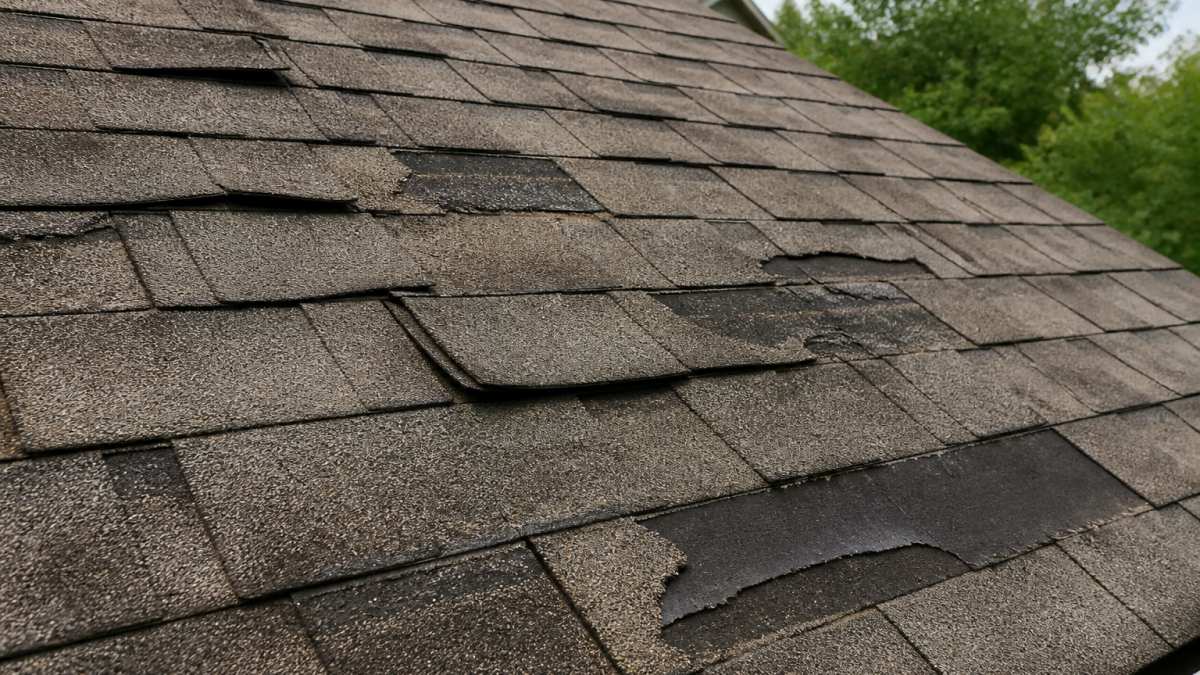
Certain warning signs indicate repair won’t solve the problem and replacement is the better choice. Recognizing them early prevents water damage and protects your home’s interior.
Curling or buckling shingles are a red flag, they’re losing the ability to shed water. Missing shingles expose underlayment and decking to moisture. Dark streaks often indicate algae or water penetrating beneath the surface.
Granule loss is another indicator: excessive granules in your gutters mean shingles are deteriorating.
Moss or algae can trap moisture and accelerate deterioration. Separated, rusted, or damaged flashing around chimneys, vents, or valleys is a common leak source and often signals surrounding material is aging too.
The 50% Rule: When Repair Stops Making Sense
The roofing industry’s 50% rule: if repair costs approach or exceed 50% of a full replacement, replacement is usually the smarter financial choice, since an aging roof will need more repairs soon.
The logic: when evaluating roof repair vs replacement cost, a 17-year-old roof with a $3,000 repair versus a $6,000 replacement makes repair seem obvious. But if it needs another repair in 2-3 years, likely given its age, you’ve spent $5,000-$6,000 on a roof still aging and eventually needing replacement.
The 50% rule isn’t absolute but is a useful benchmark: a newer roof with localized damage may be worth repairing even at 40-45% of replacement cost, while an older roof at the same ratio should probably be replaced.
Lifecycle Cost Scenarios Over 5, 10, and 20 Years
The 50% rule is a snapshot. The better question is what each option costs over the years you plan to own the home. These three illustrative scenarios use round numbers, frameworks, not predictions; your contractor’s estimate and roof condition drive the real figures.
Scenario A, Newer roof, isolated damage (about 5 years old).
- Repair now: one localized repair plus routine maintenance.
- Replacement now: full system cost, but you reset the clock on a roof with most of its life left.
- Over 5 years, repair is almost always cheaper. Over 20 years, you’ll likely replace once regardless, repairing now defers, rather than avoids, the big expense.
Scenario B, Mid-life roof, moderate damage (about 12 years old).
- Repair now: a mid-size repair, with a chance of one or two follow-ups within 5-10 years.
- Replacement now: full cost, but no further repair spending for the new roof’s life.
- Over 5 years, repair usually wins on cash outlay. Over 10-20 years, cumulative repairs often close the gap and can exceed replacement cost, since you pay labor repeatedly on an aging roof.
Scenario C, Older roof, widespread damage (18+ years old).
- Repair now: likely followed by more repairs within a few years; replacement is coming regardless.
- Replacement now: you pay once and stop the cycle.
- Over 10-20 years, replacement is typically the lower total cost, since the repair path stacks service calls onto a roof already near the end of its life.
The pattern across all three scenarios: repair wins on short horizons and on young roofs; replacement wins on long horizons and on old roofs. The crossover point is driven by your roof’s remaining service life, not by the size of the first repair bill.
How to Run Your Own Comparison
You don’t need a spreadsheet, just three inputs:
- Your roof’s remaining service life. Subtract its age from its material’s expected lifespan. Asphalt shingles run 15-20 years; metal, tile, and slate run longer. A roof with only a few years left makes any repair a short-term patch.
- The realistic repair path, not just the first repair. Ask your contractor what else is likely to fail in 5-10 years given the roof’s age and condition. One repair is a data point; a pattern is the signal.
- Your ownership horizon. Selling within a few years? A repair that gets you there may be rational, and a new roof may not return its cost at sale. Staying 10+ years? Lifecycle math usually favors replacement on an aging roof.
Lay both paths side by side over the horizon you care about, 5, 10, or 20 years, and compare total dollars, not the first invoice. That comparison, plus an itemized written estimate, turns the 50% rule from a guess into a decision.
Insurance, Financing, and Making Your Decision
For storm damage, insurance can significantly affect the decision. Policies typically cover hail, wind, and weather events but not age or lack of maintenance.
This is where an experienced restoration contractor helps. At Sunset Restoration, we navigate the insurance process: assessing whether repair or replacement is appropriate, preparing claim documentation, and advocating for fair coverage.
Financing is another consideration. If replacement cost is a concern, ask about flexible payment options, many contractors, including Sunset Restoration, offer financing.
The decision ultimately depends on your roof’s age, damage extent, finances, and how long you’ll stay. A 10-year-old roof with localized damage is a clear repair candidate; an 18+ year-old roof with multiple problem areas is a replacement candidate.
Your roof protects everything you own, so choosing correctly between repair and replacement protects your investment and peace of mind. If you’re facing roof damage, get a detailed evaluation from our licensed team. GET A QUOTE with Sunset Restoration and understand your options with clarity and confidence.
Frequently Asked Questions
What is the 50% rule in roofing?
The 50% rule is a common decision guideline: if repair costs exceed 50% of replacement cost, replacement is typically the better financial choice. This rule accounts for the fact that an older roof requiring major repairs will likely need replacement soon anyway. However, the actual threshold depends on your roof’s age, remaining lifespan, and whether you plan to stay in your home long enough to recoup the replacement investment.
How do you know whether a roof needs repair or replacement?
A roof needs repair if damage is localized (a few shingles, small leaks, or limited storm damage) and your roof is less than halfway through its expected lifespan. You need replacement if damage is widespread, your roof is near the end of its lifespan, you’ve had multiple repairs in the past few years, or interior water damage is visible. A professional inspection will determine which is appropriate for your situation.
Is it cheaper to repair a roof or replace it?
Repair is cheaper upfront, but replacement may be more cost-effective long-term. A single repair might cost a few hundred dollars, while replacement costs significantly more initially. However, if your roof is old and prone to repeated repairs, replacement eliminates future repair costs and provides peace of mind. Consider your roof’s age, damage extent, and how long you plan to stay in your home when weighing the decision.
When does repairing a roof stop being worth the cost?
Repairs stop being worthwhile when they become frequent, when your roof is past 75% of its expected lifespan, or when cumulative repair costs approach replacement cost. If you’ve had multiple repairs in the last 2-3 years or your roof is 15+ years old, replacement often makes financial sense. A contractor can assess whether your roof’s remaining service life justifies continued repairs.
